
Welcome to Felicia Jones’ Insight into CBD and Banking

Embark on a unique journey with Felicia Jones, a pioneering figure at the crossroads of the banking industry and the burgeoning world of CBD and Cannabis markets. Since 2016, I’ve dedicated my career to bridging the gap between traditional banking services and the innovative potential of Cannabis businesses.
Through my blog, I aim to demystify the financial challenges and opportunities within the CBD sector, offering valuable insights, guidance, and education to entrepreneurs and enthusiasts alike. Join me as we explore the evolving landscape of Cannabis banking, unlocking potential and fostering growth in this dynamic industry.
- Why Athletes are Turning to Hemp Creams for Recovery

Athletic competition puts enormous physical strain on their bodies, which is great for improving performance but may lead to injuries and sore muscles.
CBD can assist athletes in quickly returning to competition by relieving pain and discomfort quickly. CBD creams are especially helpful at soothing sore muscles and joints.
1. Hemp May Reduce Inflammation
Working out exposes your muscles to damage from exercise itself and other sources like temperature. This may prompt your body to produce inflammatory chemicals which lead to pain and discomfort in your muscles.
Hemp creams can provide instantaneous relief from aching joints and muscles, reduce inflammation and speed recovery from exercise faster. Plus, their topically applied application leaves no sticky residue!
Quiet Monk’s cooling CBD cream features menthol and other cooling ingredients for maximum effectiveness, with an appealing rosemary mint fragrance. Additionally, this cream features primary essential oils, natural ingredients and broad spectrum CBD for an all-around cooling effect. All products undergo third-party testing for heavy metals, molds and pesticides using organic U.S. grown hemp. They advise starting out small before gradually increasing dosage until your desired effect has been reached – free from sulfates, phthalates parabens dyes synthetic ingredients while its nourishing oils and moisturizing shea butter make this cream luxuriously soothing on your skin!
2. Soothes Muscles
CBD creams are ideal for targeting specific areas where pain exists, and should be combined with oral CBD drops to achieve an efficient method for alleviating it.
Hemp seed oil contains high concentrations of Omega-3 and Omega-6 essential fatty acids that have been shown to reduce inflammation, soothe muscles and support healthy cell growth – qualities which make this an ideal product for muscle recovery.
After your workout, using this cream can help alleviate post-workout soreness that is so common among fitness enthusiasts. Its formula incorporates camphor – an extract from trees that provides warming sensation – and menthol crystals for cooling effects, plus no pesticides, GMOs or organic U.S.-farmed hemp to provide a pesticide-free product with no cooling sensation or cooling effects.
This lightweight formulation can easily absorb into all skin types and is paraben-free for ultimate safety. Packed with soothing aloe vera extract and pink grapefruit peel oil to ease pain and swelling, as well as no artificial dyes or fragrances, this lotion also contains no artificial dyes or fragrances and paraben-free components.
3. Soothes Joints
No matter if it’s post-workout soreness or chronic joint discomfort, CBD creams offer soothing solutions. Quiet Monk CBD offers one such cream featuring cooling menthol for soothing effects and all-natural CBD hemp oil to aid recovery; its lotion application makes it suitable pre and post workout use.
This CBD cream features cooling capabilities thanks to menthol and is packed with soothing botanical ingredients such as rosemary extract, peppermint oil, chamomile oil and white willow bark extract – as well as shea and cocoa butters as well as jojoba oil for maximum nutrition and benefit.
Quiet Monk offers an innovative product: their broad-spectrum CBD cream with no trace amounts of THC is specially formulated with Hemp Seed and Coconut oils as well as Arnica Clove Helichrysum Wintergreen Peppermint essential oils to provide a warming and relaxing effect. Plus it comes in an easy twist-and-pump bottle for effortless application!
4. Reduces Pain
CBD creams can help ease muscle soreness and promote recovery after exercise, often featuring cooling menthol for extra pain relief. Furthermore, these products contain other natural ingredients designed to reduce inflammation, soothe the skin, and replenish essential nutrients.
Quiet Monk CBD muscle recovery cream is an easy-to-absorb non-greasy formulation containing helichrysum oil to increase circulation for deeper relief, full spectrum hemp extract with trace amounts of THC and botanical oils such as peppermint and rose hip for additional benefits.
This CBD product is a powerhouse of healing, with a potency CBD dosage and coconut oil to sooth skin irritations. Infused with cooling menthol for added relief and other soothing ingredients like white willow bark extract, camphor oil and wintergreen oil for maximum therapeutic effectiveness, this cream is an ideal option for sensitive skin that requires targeted topical application.
- How the Banking Industry Works for Cannabis in Madrid
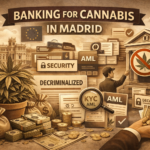
Cannabis activity in Madrid operates within one of Europe’s most legally nuanced frameworks—and banking is where those complexities become most visible. While cannabis use in private spaces is decriminalized in Spain, financial institutions remain cautious, particularly when cannabis-related activity intersects with payments, accounts, or formal business structures.
Understanding how banking works for cannabis in Madrid requires looking at Spanish law, EU financial regulations, and risk management practices used by banks.
The Legal Context Shapes Banking Access
Spain does not legalize commercial cannabis sales. Instead, cannabis access is largely provided through private, non-profit cannabis social clubs. This distinction is critical for banks.
From a banking perspective:
- Retail cannabis businesses do not legally exist
- Cannabis clubs are classified as private associations
- Profit-making from cannabis is prohibited
- Transparency and documentation are essential
Because clubs are not commercial sellers, they cannot operate like dispensaries—and banks treat them accordingly.
Why Banks Are Cautious With Cannabis in Spain
Spanish banks are governed by:
- National anti-money laundering laws
- EU AML directives (AMLD)
- Know Your Customer (KYC) requirements
- Terrorist financing prevention rules
Cannabis, even when tolerated under Spanish law, is still considered a high-risk sector for financial institutions due to:
- Legal gray areas
- Inconsistent regional enforcement
- Potential exposure to illicit markets
- International compliance concerns
As a result, banks adopt a risk-avoidance approach, especially in Madrid.
How Cannabis Clubs Handle Banking in Madrid
Most compliant cannabis social clubs in Madrid take a conservative financial approach to reduce banking risk. Similar to cannabis madrid.

Common practices include:
- Operating as registered non-profit associations
- Using standard association bank accounts (when possible)
- Avoiding cash-heavy public-facing transactions
- Maintaining detailed accounting records
- Limiting financial activity strictly to member fees and expenses
Even then, not all banks will accept cannabis clubs as clients. Some clubs experience account closures or refusals without explanation, reflecting banks’ internal risk policies rather than explicit illegality.
Cash Use and Its Risks
Because banking access is limited, some cannabis clubs rely more heavily on cash. While not illegal in itself, this creates additional risks:
- Increased scrutiny under AML rules
- Greater accounting burdens
- Security concerns
- Difficulty demonstrating transparency
Spanish authorities increasingly expect traceable, well-documented finances, even from non-profit associations.
Payment Processing: Cards and Digital Payments
Traditional card processors (Visa, Mastercard-linked services) generally do not support cannabis-related activity in Spain, even for clubs operating legally.
As a result:
- Card payments are rare or unavailable
- Digital wallets may be restricted
- Membership fees are often handled offline
- Clubs avoid labeling transactions as cannabis-related
This contrasts sharply with fully legalized markets and reinforces why Madrid’s cannabis ecosystem remains intentionally low-profile.
Implications for the Broader Cannabis Industry
Madrid’s banking environment highlights a key lesson for policymakers and industry observers: partial decriminalization without commercial regulation creates financial bottlenecks.
Key implications:
- Legal tolerance does not equal financial inclusion
- Banking access lags behind social acceptance
- Transparency requirements are high but support tools are limited
- Reform conversations increasingly include financial infrastructure
For advocates, this strengthens arguments that clearer regulation would improve compliance, reduce cash reliance, and enhance oversight.
Looking Ahead: Will Banking Change?
There is ongoing discussion within Spain and the EU about:
- Standardizing cannabis policy
- Clarifying the legal status of social clubs
- Improving financial transparency for associations
Until formal regulation exists, banks in Madrid are likely to remain cautious. Clubs and individuals operating responsibly must continue to prioritize compliance, documentation, and legal guidance.
Final Thoughts
Cannabis in Madrid exists in a space where law, culture, and finance intersect carefully. While private use is tolerated, the banking industry operates on strict risk controls that limit access and flexibility for cannabis-related entities.
Understanding how banking works in this environment is essential—not just for clubs, but for policymakers, researchers, and industry stakeholders tracking global cannabis models.
Madrid shows that cannabis reform is not only about legality—it’s also about financial systems, compliance structures, and institutional trust.
- How the Banking Industry Works for Cannabis in Madrid
Cannabis activity in Madrid operates within one of Europe’s most legally nuanced frameworks—and banking is where those complexities become most visible. While cannabis use in private spaces is decriminalized in Spain, financial institutions remain cautious, particularly when cannabis-related activity intersects with payments, accounts, or formal business structures.
Understanding how banking works for cannabis in Madrid requires looking at Spanish law, EU financial regulations, and risk management practices used by banks.
The Legal Context Shapes Banking Access
Spain does not legalize commercial cannabis sales. Instead, cannabis access is largely provided through private, non-profit cannabis social clubs. This distinction is critical for banks.
From a banking perspective:
- Retail cannabis businesses do not legally exist
- Cannabis clubs are classified as private associations
- Profit-making from cannabis is prohibited
- Transparency and documentation are essential
Because clubs are not commercial sellers, they cannot operate like dispensaries—and banks treat them accordingly.
Why Banks Are Cautious With Cannabis in Spain
Spanish banks are governed by:
- National anti-money laundering laws
- EU AML directives (AMLD)
- Know Your Customer (KYC) requirements
- Terrorist financing prevention rules
Cannabis, even when tolerated under Spanish law, is still considered a high-risk sector for financial institutions due to:
- Legal gray areas
- Inconsistent regional enforcement
- Potential exposure to illicit markets
- International compliance concerns
As a result, banks adopt a risk-avoidance approach, especially in Madrid.
How Cannabis Clubs Handle Banking in Madrid
Most compliant cannabis social clubs in Madrid take a conservative financial approach to reduce banking risk. Similar to cannabis madrid.
Common practices include:
- Operating as registered non-profit associations
- Using standard association bank accounts (when possible)
- Avoiding cash-heavy public-facing transactions
- Maintaining detailed accounting records
- Limiting financial activity strictly to member fees and expenses
Even then, not all banks will accept cannabis clubs as clients. Some clubs experience account closures or refusals without explanation, reflecting banks’ internal risk policies rather than explicit illegality.
Cash Use and Its Risks
Because banking access is limited, some cannabis clubs rely more heavily on cash. While not illegal in itself, this creates additional risks:
- Increased scrutiny under AML rules
- Greater accounting burdens
- Security concerns
- Difficulty demonstrating transparency
Spanish authorities increasingly expect traceable, well-documented finances, even from non-profit associations.
Payment Processing: Cards and Digital Payments
Traditional card processors (Visa, Mastercard-linked services) generally do not support cannabis-related activity in Spain, even for clubs operating legally.
As a result:
- Card payments are rare or unavailable
- Digital wallets may be restricted
- Membership fees are often handled offline
- Clubs avoid labeling transactions as cannabis-related
This contrasts sharply with fully legalized markets and reinforces why Madrid’s cannabis ecosystem remains intentionally low-profile.
Implications for the Broader Cannabis Industry
Madrid’s banking environment highlights a key lesson for policymakers and industry observers: partial decriminalization without commercial regulation creates financial bottlenecks.
Key implications:
- Legal tolerance does not equal financial inclusion
- Banking access lags behind social acceptance
- Transparency requirements are high but support tools are limited
- Reform conversations increasingly include financial infrastructure
For advocates, this strengthens arguments that clearer regulation would improve compliance, reduce cash reliance, and enhance oversight.
Looking Ahead: Will Banking Change?
There is ongoing discussion within Spain and the EU about:
- Standardizing cannabis policy
- Clarifying the legal status of social clubs
- Improving financial transparency for associations
Until formal regulation exists, banks in Madrid are likely to remain cautious. Clubs and individuals operating responsibly must continue to prioritize compliance, documentation, and legal guidance.
Final Thoughts
Cannabis in Madrid exists in a space where law, culture, and finance intersect carefully. While private use is tolerated, the banking industry operates on strict risk controls that limit access and flexibility for cannabis-related entities.
Understanding how banking works in this environment is essential—not just for clubs, but for policymakers, researchers, and industry stakeholders tracking global cannabis models.
Madrid shows that cannabis reform is not only about legality—it’s also about financial systems, compliance structures, and institutional trust.
- High-Risk Banking: From Cannabis Businesses to Digital Creators in Indiana

Since 2016, I’ve been working at the intersection of cannabis and banking, and one theme continues to repeat itself: businesses labeled “high-risk” face barriers far beyond their actual operational risks. For cannabis entrepreneurs, the challenge is federal prohibition. For other industries, it can be stigma, perception, or simply being misunderstood.
The Cannabis Banking Struggle
Even in states where cannabis is legal, many banks refuse to provide services. Entrepreneurs find themselves paying higher fees, relying on alternative financial services, or even operating in cash-heavy models that limit growth and increase risk. The reality is simple: these businesses are not more dangerous — they’re just harder for traditional financial institutions to categorize.
A Parallel in Digital Creation

Interestingly, the cannabis industry isn’t alone. Digital creators also face the same hurdles. Platforms tied to adult or alternative content are often flagged as “high-risk,” leading to denied accounts, frozen payments, or inflated transaction fees.
In Indiana, where financial conservatism runs deep, this stigma is particularly strong. Creators have found ways to adapt by building resilient communities online. Platforms like HotInIndiana.com shine a light on this reality, showcasing how creators navigate the same challenges that cannabis entrepreneurs know all too well: building livelihoods while being excluded from traditional financial systems.
Shared Lessons Across Industries
What unites cannabis entrepreneurs and digital creators is resilience. Both groups:
- Diversify their revenue streams.
- Lean on fintech and alternative payment solutions.
- Build communities that support their growth despite institutional barriers.
Why This Matters for Banking Innovation
For financial institutions willing to innovate, these industries represent untapped potential. By creating frameworks that serve high-risk but legitimate businesses, banks can not only profit but also contribute to greater economic inclusion.
Conclusion
Whether it’s a cultivator in Oregon or a creator in Indiana, the story is the same: hard-working individuals are building livelihoods in industries that traditional banking still refuses to fully embrace. It’s time for banking to evolve — and for us to recognize that resilience and entrepreneurship deserve support, not exclusion.
- Advanced Cannabis Banking Tips For FIs to Thrive in the Green Economy
While opening bank accounts for cannabis businesses may be challenging, they can still safely deposit funds and build savings and credit. Financial Institutions will need to implement strict operations and cash management best practices; but for companies operating within an increasingly regulated industry it can be well worth their while.
Invoice Financing
Invoice financing enables businesses to obtain cash advances based on the value of unpaid invoices, providing cash for essential business needs. Finance providers offering short-term funding options allow companies to quickly capitalize on growth opportunities without delay. Invoice financing can also provide relief during times of emergency, such as natural disasters that damage inventory or any disruption from suppliers or bankruptcy of key customers. Lenders typically prefer businesses with strong financial histories and diverse customer bases, and may require personal guarantees in order to secure funding. Furthermore, lenders will assess existing debt obligations to determine if your business can repay its loan obligation in full.
Before seeking invoice financing, be sure to compare rates and fees in detail in order to find the most cost-effective solutions.
Real Estate Loans
Evergreen loans (commonly referred to as sustainable financing) provide green businesses with access to capital they need for environmentally-friendly activities such as reforestation efforts or renewable energy projects. Accelerators can accelerate the transition towards a net zero carbon economy by providing necessary capital. They may also help attract investors and strategic partners who prioritize sustainability and environmental impact as part of their agenda. Evergreen loans provide an avenue for international cooperation by allowing investors from various nations to pool their resources for environmental projects in vulnerable regions – for instance funding large-scale reforestation efforts together.
Casual Loans
Casual workers may benefit from casual loans, which are unsecured personal loans designed specifically to cater to those without traditional proof of income. Funds will be directly deposited into your bank account so you can spend it how you please – just meet your repayment commitment each week, fortnight or month! Casual workers may also look into low-doc home loans which allow them to qualify for mortgages without providing documentation with typical proof of income requirements – although they usually incur higher interest rates.
- Unlock the Secrets to Cannabis Banking – A Must-Read Guide
Cannabis businesses operating legally require banking services. Most banks do not provide them due to additional monitoring, due diligence requirements, and staffing needs associated with cannabis banking services.
Instead, growers, dispensaries and ancillary businesses often must manage huge sums of cash – creating risks such as theft, skimming and robbery – but with proper approach and strategy secured banking options are achievable.
1. Know the Rules
Legal cannabis businesses are growing quickly across the nation, while federal banking regulations lag behind. Due to anti-money laundering regulations, financial institutions often remain reluctant to work with this sector, leaving legitimate, law-abiding businesses to operate solely using cash, which poses risks both to customers and employees alike.
To address this complex situation, ICBA supports the SAFE Banking Act. This bill would enable banks to provide basic services to cannabis-related businesses without fear of government or regulatory reprisals.
This bill would ensure that industry businesses are held to account for their business activities, making them more transparent and less likely to participate in illegal activity. Even if an institution opts not to offer cannabis banking, its BSA officers must understand how to assess risk accurately and adapt policies appropriately – for instance when considering hemp/CBD related accounts it must refer back to state/local laws when making risk evaluation decisions.
2. Be Prepared
Cannabis banking can be complex and time consuming. Financial institutions must be able to demonstrate that each dollar of revenue generated from legal sales; additionally they must meet federal and state reporting requirements and submit tax reports as required. All this takes up both time and resources – which explains why financial institutions charge cannabis accounts a fee.
The SAFE Banking Act would ensure that federal regulators would not take adverse actions against banks that provide services to state-legal marijuana-related businesses (MRBs). While it has passed several times through the House of Representatives, it has yet to reach the Senate floor for voting.
Cannabis operatorss can prepare themselves for banking by demonstrating financial health and handling cash responsibly, being open with potential bank partners, and working with an institution that understands cannabis. Green Check Connect helps FIs build cannabis banking programs through our marketplace of verified operators and suite of tools designed to make onboarding smoother for both parties involved.
3. Demonstrate Financial Health
Financial transactions such as electronic payments, money transfers and ACH have become more widespread, necessitating businesses to use electronic platforms instead of cash for transactions. Cannabis banking facilitates these digital transactions while increasing record keeping efficiency as well as meeting tax and legal compliance. Furthermore, its increased efficiency of payments could help dispensaries attract additional investors.
Even though marijuana is legal in an increasing number of states, its federal illegality makes accessing financial services difficult for cannabis-related business (CRB). Banks and credit unions remain reluctant to work with CRBs because they fear breaking the law by doing so.
To overcome lenders’ hesitation when working with marijuana-related businesses, lenders need to fully comprehend both risks and rewards associated with working with such enterprises. Abrigo’s team of former bankers and BSA Officers can assist your institution with developing policies to stay compliant when providing cannabis-related banking. Check back here regularly for on-demand webinars featuring Abrigo!
4. Be Transparent
Cannabis is still a relatively young and emerging industry, and banks understandably remain wary about providing banking services to cannabis businesses that operate legally within state borders. Most financial institutions that do provide such services remain discreet about it and keep a low profile when offering them.
Banks and credit unions that choose to work with CRBs must still abide by anti-money laundering (AML) laws, perform extra customer due diligence checks and report suspicious activity reports.
Marijuana and hemp-related businesses (MRBs) continue to thrive despite federal prohibition, yet without banking options most legal, fully compliant MRBs operate solely on cash; this poses both regulatory difficulties as well as security threats to millions working in this sector. When these MRBs gain access to safe banking services that work reliably for everyone involved – everyone benefits! To speed up this process it’s essential that businesses be transparent during application procedures – having all required documents organized can speed things along significantly; click here for our guide on preparing cannabis banking application procedures!
- Cannabis Banking: The Key to Unlocking Industry Growth
As 36 states now permit cannabis use, financial institutions cannot ignore this rapidly expanding industry – but must also be prepared for its unique compliance challenges.
For optimal risk mitigation, banks should define their risk appetite with banking CRBs and create systems to prioritize compliance. This may involve using AML software to detect suspicious transactions as well as KYC solutions that efficiently onboard and verify customers.
Legality
Legality is an issue of great concern to the cannabis banking industry. Although state-sanctioned businesses should have access to traditional banking services, federal prohibitions remain an obstacle.
Due to regulatory enforcement and potential reputational damage concerns, many bankers have been reluctant to work with cannabis clients; however, due to an increasing demand for banking services they are reconsidering their stance.
Banking cannabis clients is costly, as it requires additional staff to comply with bank secrecy and anti-money laundering laws. One banker could oversee as many as 30 cannabis customers compared with regular business.
Cash-only solutions pose operational issues for cannabis businesses, including increased safety risks associated with robberies and theft, tracking expenses accurately for tax filing purposes and providing employees with adequate retirement plans (401(k).
Regulations
As more states legalize marijuana, banks are looking for ways to support this growing industry. Unfortunately, federal laws and banking regulations present many hurdles; banks risk prosecution for money laundering if they work with cannabis-related businesses (CRBs), even when state laws allow these operations legally.
Although cannabis businesses have experienced considerable de-stigmatization and steady progress toward legalization in state after state, most federally chartered banks continue to reject them as viable customers, forcing companies to keep large sums of cash on hand – leaving them exposed to theft or other crimes.
To combat the issue, some states have implemented closed-loop payment processing systems wherein the state acts as the payment processor. This enables states to monitor and track tax payments from dispensaries as well as purchase payments from consumers more easily while eliminating cash handling which poses security concerns for employees and customers alike. Banks should assess risks by tiering cannabis clients according to risk; Tier 1 represents those considered the lowest.
Technology
Prioritizing compliance can make banking accessible for cannabis businesses, ensuring adherence with regulations and lowering risks associated with fines or damage to reputation; further enabling efficient growth while drawing investors.
Cannabis businesses that lack access to traditional bank services have often been forced to operate all-cash, making their operations vulnerable to theft and crime. Now there is hope: federal lawmakers have proposed the SAFE Banking Act which creates an exemption that enables financial institutions to actively bank cannabis-related businesses.
Such solutions would enable these institutions to accept deposits and lend money without fear of violating CSA or anti-money laundering laws, and could codify into law the stringent know-your-customer standards already required by FinCEN guidelines. Nonetheless, their effectiveness relies heavily on regulatory changes, industry collaboration, and ongoing technological improvements.
Compliance
As more states legalize cannabis, financial institutions need to understand its implications. Although cannabis remains illegal at a federal level, banks can still service marijuana-related businesses (CRBs) provided they abide by certain procedures and comply with suspicious activity monitoring requirements.
ICBA supports legislation which would create an effective safe harbor from government and regulatory reprisal for community banks serving Cannabis Retail Businesss (CRBs). Such protection should extend to “ancillary” services provided such as commercial landlords, accounting firms, utility providers and others who may receive payments derived from cannabis sales proceeds.
Last week, bipartisan senators introduced the SAFE Banking Act as a positive step in the right direction. But it must be kept in mind that this bill only provides limited bank access for marijuana businesses; true solutions lie with federal authorities and their banking industry counterparts.